
Introduction
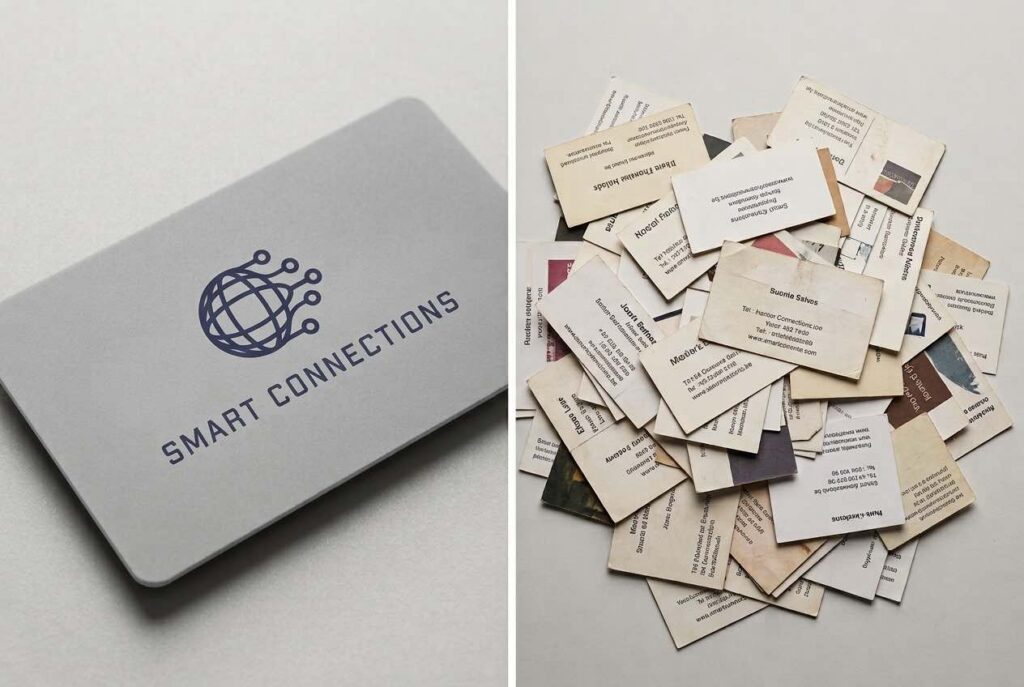
In the fast-paced landscape of modern B2B commerce, first impressions remain the bedrock of long-term commercial success. Whether at a high-stakes trade show in Brussels, an executive roundtable, or a casual networking mixer, the ritual of exchanging contact information is a timeless tradition. However, while enterprises invest millions of euros into cutting-edge CRM systems, cloud computing infrastructure, and marketing automation suites, one critical touchpoint has remained stubbornly trapped in the 19th century: the traditional paper business card.
For mid- and large-size companies, relying on printed paper cards represents an operational blind spot that incurs hidden environmental liabilities, manual administrative bottlenecks, and missed revenue opportunities. Every year, corporate procurement departments spend significant capital designing, printing, and shipping boxes of premium cardstock to their field sales, account management, and executive teams. Yet, the lifetime of these physical assets is shockingly short, and their utility in driving modern sales pipelines is near zero.
As forward-thinking firms across Europe prioritize both digital transformation and strict Environmental, Social, and Governance (ESG) compliance, corporate leaders are discovering that transitioning to enterprise-grade digital business cards is no longer an optional novelty—it is a strategic growth lever. This comprehensive analysis evaluates the structural, economic, and ecological realities of digital business cards compared to traditional paper cards, demonstrating how shifting away from physical cardstock can open more doors, streamline lead capture pipelines, and ultimately close more deals.
💡 Quick summary: key benefits at a glance
ESG Impact: 100% elimination of physical paper waste and a 99.9% reduction in card-related carbon emissions.
Direct Cost Savings: Cut recurring procurement expenses by up to 90%, with an immediate 26% lower annual cost per employee compared to paper cards (€48.00 vs. €64.23).
Pipeline Efficiency: Achieve a 63% increase in lead management efficiency and 16% higher lead conversion rates.
Seamless CRM Integration: Automate data entry via direct sync with major platforms like Salesforce, HubSpot, and Microsoft Dynamics.
1. ESG & Environmental impact: enterprise digital business cards vs. paper
The physical and environmental toll of the corporate printing press is massive, yet frequently overlooked by executive teams. According to an extensive industry analysis on the hidden environmental impact of business cards, approximately 10 billion business cards are printed globally every year. The sobering operational reality is that 88% of these physical cards end up in the trash within a single week of distribution. This creates a linear “take-make-waste” cycle that completely undermines corporate sustainability frameworks.
When broken down into quantifiable metrics, the ecological footprint of paper business cards for large organizations is staggering. For an enterprise with 10,000 employees, supplying each team member with a standard allocation of 500 cards per year requires the manufacturing and distribution of 5 million individual physical cards. This volume consumes approximately 1,455 kilograms of paper waste and releases 3,774 kilograms of CO2 emissions into the atmosphere annually.
Furthermore, according to research on digital business card statistics, the pulp and paper manufacturing process is highly water-intensive; producing cards for a 10,000-employee company drains over 151,000 liters of water each year. Globally, transitioning to digital business cards saves an estimated 7 million trees annually, transforming what used to be a chronic administrative waste stream into a massive sustainability win.
By adopting digital alternatives, enterprises achieve a 99.9% reduction in annual business card carbon emissions (dropping from 3,774 kg down to just 3.6 kg of data-center related emissions) and eliminate physical paper waste by a full 100%.
2. Automated CRM integration: accelerating B2B lead capture
The environmental benefits of digital corporate cards are compelling, but their true operational power lies in their ability to eliminate data entry friction and accelerate sales pipeline velocity. Traditional paper networking relies on a deeply flawed, manual process: a sales representative collects dozens of paper cards at an industry conference, stuffs them into a blazer pocket, and then returns to the office with the tedious task of manually typing that data into a CRM system.
In practice, this manual workflow is where high-value leads go to die. Market analysis on digital business card efficiency statistics reveals that companies switching to digital business cards experience a 45% reduction in contact management time and a 63% increase in lead management efficiency. Because paper business cards do not speak to modern sales software, data becomes siloed, delayed, or lost entirely.
Enterprise digital business cards bridge this gap completely. When an account executive shares their digital card via an NFC tap or a quick QR code scan, the recipient does not merely look at an image; they interact with a live web link or vCard file that can instantly sync back to the enterprise’s central database. Sophisticated systems can integrate directly with major platforms like Salesforce, HubSpot, and Microsoft Dynamics.
The moment a contact exchange occurs, the system automatically tags the lead by event location, assigns it to the appropriate regional sales team member, and triggers an automated follow-up email before the prospect even leaves the conversation.
The financial upside is measurable: digital card recipients are 16% more likely to convert into active paying customers, simply because the barrier to engagement is minimized and follow-up occurs while the relationship is still warm.
3. Continuous visibility & dynamic branding: persistent B2B interactions
A paper business card is a static, rigid medium. The moment it leaves a sales representative’s hand, its content is frozen in time. If the representative changes their mobile number, if the corporate branding guidelines shift, or if the marketing team launches a critical new product video, the physical paper card cannot adapt. It remains an obsolete artifact that risks misrepresenting the organization’s current market positioning.
Digital business cards rewrite this dynamic by providing continuous visibility and real-time remote control over corporate branding. Because digital cards are hosted in secure cloud environments, they serve as living marketing portals. If an employee is promoted from Senior Account Manager to Director of Business Development, a centralized administrator can update their corporate profile instantly via an administrative dashboard. The change is pushed live immediately across all previously distributed links and saved contacts.
Furthermore, research on digital business card sharing behavior notes that digital business cards are 700% more likely to be shared than traditional paper alternatives. Sharing a physical card requires proximity; sharing a digital card requires a simple link forward via WhatsApp, LinkedIn, or email.
Moreover, over 50% of digital business card views result in a direct action—such as a recipient clicking an embedded link to watch a product demo, scheduling an introductory meeting via an integrated widget (such as Calendly), or exploring a newly published corporate whitepaper.
This turns paper networking into a trackable digital marketing channel. Corporate communications teams gain unprecedented insight into which representatives are generating the highest engagement and which marketing assets are resonating most effectively with prospects during field interactions.
4. Operational and financial comparison: paper vs. digital cards
To fully appreciate the business case for digital adoption, the structural, economic, and operational differences between traditional paper cards and enterprise-grade digital solutions are contrasted below:
| Feature / Metric | Traditional paper business cards | Enterprise digital business cards |
| Procurement & Overhead Costs |
€64.23 average recurring expenditure per employee annually. |
~€48.00 per employee annually on a predictable SaaS model (26% direct savings). |
| Rebranding & Modifications |
Static data; changes force total discard, resulting in up to 90% wasted print costs. |
Real-time centralized editing; instant updates pushed across all active contacts. |
| Data Accuracy & Entry |
Manual typing with high latency and high error rate; contacts easily lost. |
Instant lead transfer with direct mapping to Salesforce, HubSpot, and Dynamics. |
| Lead Efficiency & ROI |
No interaction tracking; manual follow-ups cause high lead drop-off. |
63% increase in lead efficiency; recipients 16% more likely to convert to clients. |
| Environmental & ESG Impact |
10B cards printed annually; 88% landfilled in 1 week; massive water and paper waste. |
100% paper waste reduction; 99.9% reduction in card-related carbon footprint. |
Conclusion: step into the future of B2B networking
The evidence is clear: traditional paper business cards are an operational relic that drains corporate budgets, expands ecological footprints, and introduces friction into the sales pipeline. For mid- and large-size enterprises striving to maintain a competitive edge, the status quo is no longer viable.
By upgrading to an enterprise-grade digital business card solution, your organization can simultaneously achieve key strategic goals: drastically reducing administrative print waste by 100% to support corporate ESG mandates, cutting recurring procurement expenses by up to 90%, and supercharging sales efficiency through seamless CRM automated workflows. Every tap of a digital card opens a direct, trackable, and dynamic channel between your business and a future client.
Do not let your sales force carry outdated tools into a digital marketplace. It is time to empower your teams to network smarter, build stronger relationships, and drive measurable revenue growth.
Take action today
Visit our ‘book a demo’ page to schedule a custom demonstration of our enterprise digital business card platform. Discover how we can help your organization transition seamlessly, automate your lead capture pipelines, and give your sales professionals the ultimate tool to open more doors and close more deals.
Consulted industry sources
-
businesscards.io Report (2026): The Hidden Environmental Impact of Business Cards (And Why Going Digital Changes Everything).
-
Wave Connect Market Analysis (2026): 30 Digital Business Card Statistics You Need to Know.
-
Digital Business Card (DBC) Industry Insights (2026): 50 Digital Business Card Statistics in 2026: Trends and Insights.
-
QR Tiger Research (2026): Key Digital Business Card Statistics You Need to Know.