
In 2026, we are exchanging contacts with a tap of an NFC-enabled ring or a swipe on a phone screen. It seems archaic to carry around standard-sized rectangles of laminated paper. Yet, for many B2B industries, the physical business card remains the final stronghold of paper in the corporate world.
But why? The business card didn’t start as a professional necessity. For centuries, it was a social gatekeeper, an aristocrat’s tool of etiquette. The transformation of this small artifact into a fundamental component of the employee toolkit is a story driven by necessity, trust, and the global expansion of industry.
Here is how the Industrial Revolution minted the modern B2B employee card.
1. The heritage: visiting and trade cards
Before it entered the boardroom, the business card existed in two separate, distinct ancestors:
The ‘carte de visite’
Emerging in 17th-century France during the reign of Louis XIV, these cards were strictly social. If you wished to call upon a person of high status, you did not simply knock. You left your carte de visite with their servant. It was a formal notification of your presence and social intent. These cards were miniatures of art, often featuring intricate family crests and calligraphy, designed to establish your lineage and social standing.
The trade card
While aristocracy relied on etiquette, the working class relied on commerce. In 18th-century England, merchants and tradesmen began using “trade cards”. These were primitive but vital advertisements. Crucially, before towns adopted formal street numbering systems, these cards functioned as maps. The back of the trade card often featured hand-drawn directions to the merchant’s shop, “opposite the Thames River near the butcher’s.”
2. The merger: the rise of the B2B employee
The Industrial Revolution in the 19th century changed everything. Businesses were no longer small, single-owner shops; they were becoming large, multi-state, or even multinational corporations. This complexity birthed a new class of professional: the middle manager and the traveling salesman.
This transformation created a “trust gap” that only the merger of the social and commercial card could fill.
Standardizing contact in an analog world
Before the telephone became ubiquitous, the physical exchange of information was the only way to ensure future communication. A salesman visiting an iron foundry in 1880 had to provide not just his own name, but three crucial data points to stay competitive:
- The Corporation he represented.
- His standardized location (physical address) where a purchase order could be mailed.
- His specific Job Title, clarifying his authority to make deals.
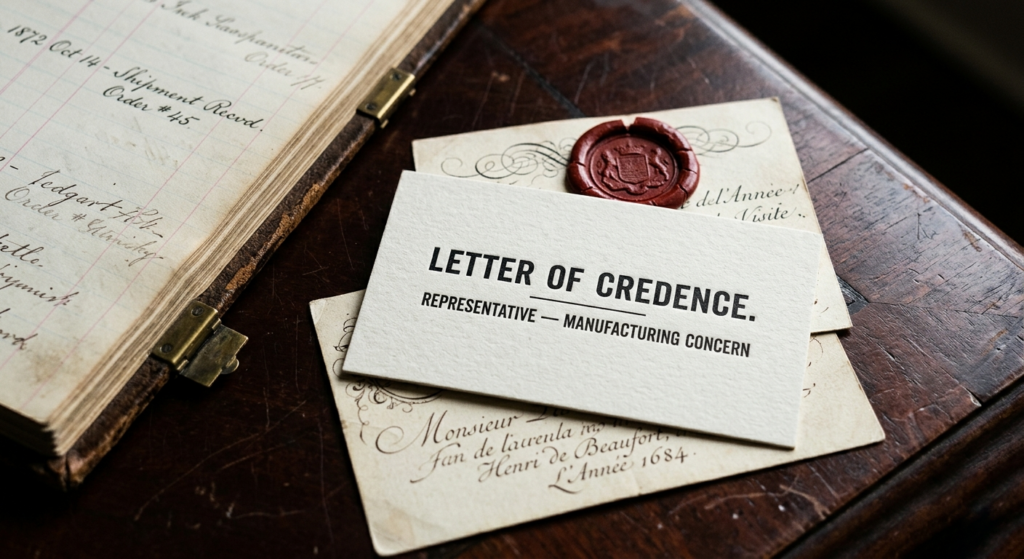
The card as a letter of credence
The single most important development in B2B context was when corporations, not the individual employees, began providing these cards to their staff.
When an employee handed out a card from “The Standard Oil Company,” the card acted as a miniature, handheld “Letter of Credence.” In an era prone to fraudulent hucksters, the card lent the employee the company’s established brand equity. It proved that the employee was an authorized representative, legitimizing the meeting and building immediate trust in the organization they represented, rather than just the individual.
3. Cultural rituals of trust and hierarchy
As businesses normalized the use of cards throughout the 20th century, the card itself became a global language of respect and hierarchical ordering. In many cultures, the exchange became a formalized B2B ceremony.
In Japanese business culture, the practice of Meishi is not merely an exchange of information; it is a ritual establishing rank. The card must be presented with both hands, with the text facing the recipient, and often accompanied by a bow. Critically, the standard US card size (3,5 x 2 inches) was popularized not by legal dictate, but because it fit perfectly into the vest pockets of 19th-century gentlemen’s suits.
Take action today
Don’t get stuck in the past and visit our ‘book a demo’ page to schedule a custom demonstration of our enterprise digital business card platform. Discover how we can help your organization transition seamlessly, automate your lead capture pipelines, and give your sales professionals the ultimate tool to open more doors and close more deals.
Sources